Yard Signs
Legend:
I remember her first as a blur of motion on the elementary school playground - her curly hair bouncing as she raced past me. I didn't even see her face that day, I just heard her laughter coming from behind. That was before yard signs divided neighborhoods, before social media became a battlefield, before we learned to sort each other into political boxes.
She grew up on Balboa Island. Houses crammed together. Tight streets and alleyways. Sailboats in the harbor. Seals barking. This is where she learned to stand her ground, where her convictions took root long before they became political.
She's half Mexican, half Swedish, but 100% Latina. Her passion comes honestly - inherited from her immigrant mother, who learned to stand up for what she believed in, growing up with eight siblings in a small house in Mexico before coming to America. That same determination, along with a deep sense of justice, shapes how she sees the world. A deep self-righteousness.
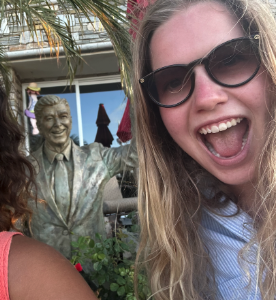
I remember one of my first disagreements with Britta. During a game of truth or dare, she challenged me to touch an old rusty statue near her house. Although it seemed silly I refused, worried it was covered in germs. But, she insisted it was clean. To prove her point, she stormed up to the handcrafted statue and pressed her palm against the cold metal, holding it much longer than necessary. Her eyes stared into mine, daring me to question her. Even then, she had to win.
Now campaign signs stand in front yards across the island. No longer just plastic stuck in grass, they are markers of identity, silent declarations of belonging. I watch Britta notice them as we walk, her expression changing with each sign she sees.
One night on her rooftop, a profound memory stays with me. We lay side by side, looking up at stars while a warm breeze rustled the plants on her table. Britta was talking about her crush: a strong 6'3" quarterback from our high school football team. As she spoke about him, her eyes lit up. You could hear the warmth in her voice, the genuine connection she felt. Then she interrupted sharply and said: "Ugh but have you heard who he supports? He's a Trump voter." She mentioned walking past his house, and stumbling upon a red sign behind his white fence. I could hear the conflict in her voice as she spoke about him - the way she wanted to ignore politics but struggled letting go of the fundamental difference in values. Her mother's voice echoed in her hesitation, and another potential connection faded before it could ever begin.
Since when did friendship fall apart because of politics? When did we stop seeing people and start seeing parties?
She scrolls through Instagram, each post reinforcing her existing beliefs, each one strengthening her convictions - just as I do, just as we all do. We're all guilty of reducing people to their political labels, treating those who think differently as aliens rather than the neighbors and classmates we grew up with.
Remember when we used to talk about dreams? About boys and music and summer plans? Now every conversation carries the weight of political meaning, every disagreement feels like a matter of principle, like a cultural war. I want to tell her that the world holds more nuance than this dichotomy, unlike her social media feed suggests. The understanding we look for often lies in a gray area that we're too afraid to explore.
But the secession grows wider. Each day, I see more young people choosing this path - refusing to date, work with, or befriend those who think differently. Complex humans are reduced to mere political beliefs, captured through monotone lenses, while the world begs for a vibrant and vivid color palette.
I look at her sometimes - my friend with the curly hair who still runs with the same enthusiasm she had on that playground. Despite her efforts to push friends away, I see the whole of her: the energetic kid, passionate teenager, and the young woman fighting for what she believes is right. I see her complexity, her humanity beyond her political beliefs. I wish she could extend that same vision to others.
We still look up at the same stars we watched that night on the rooftop, before yard signs and party lines taught us how to hate. Yet we choose to live in bubbles of our own making, letting political lines divide what nature never meant to separate.